





3 essential oils to boost concentration
You open your computer to make progress on an important file. Two notifications, a text message, a distracting tab... Ten minutes later, you've forgotten what you were doing.
Don't panic: it's not an innate lack of attention, but constant overexposure. The human brain was not designed to handle such an avalanche of solicitations. The result? Mental fatigue, difficulty concentrating, loss of efficiency.
The good news is that there are simple, natural and immediate solutions to get back on track. Among them, certain essential oils can support alertness, improve mental clarity and help you stay focused, without coffee or nervous tension.
The goal: active, yet relaxed concentration
Some essential oils act directly on the central nervous system via olfaction. By combining them intelligently, we obtain a synergy that helps to: Clarify the mind, Reduce mental fatigue, Promote stable attention
The 3 selected essential oils
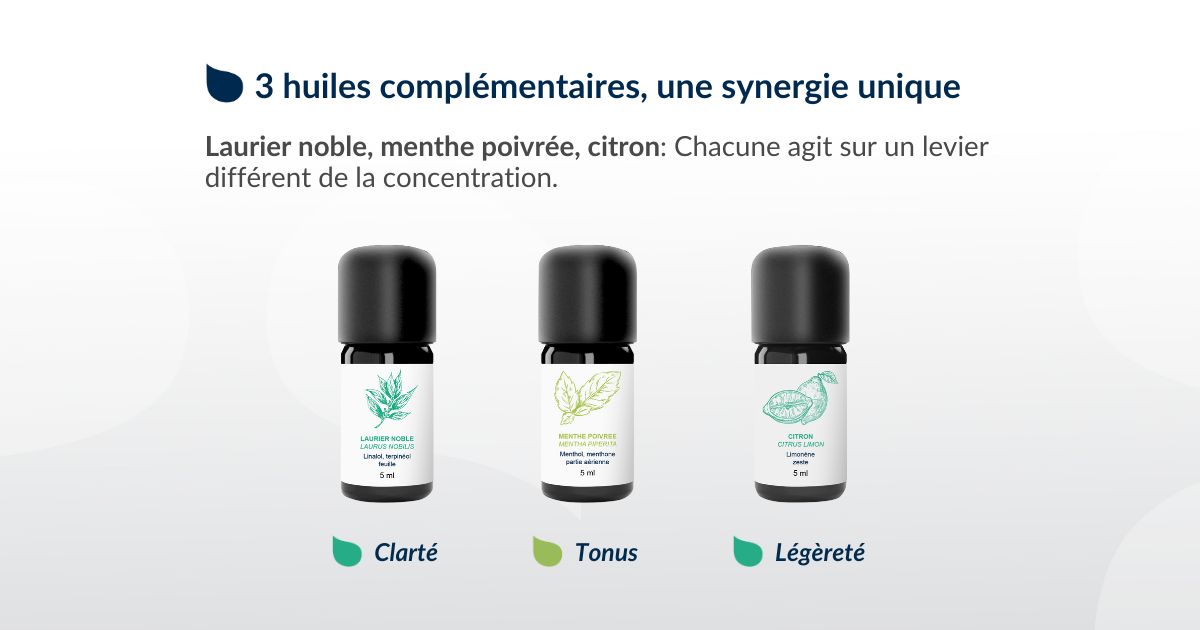

Laurel Essential Oil 100% Organic and Handcrafted
View ProductMain effect: cognitive stimulation + self-confidence
Key molecule: 1,8-cineole stimulates memory and alertness. Laurel is often used to boost clarity of mind and self-confidence. Its fresh, slightly spicy fragrance evokes lucidity and decision-making.
Further information: 1,8-cineole is recognized for its positive effects on cognitive functions. It improves cerebral oxygenation and supports the cholinergic system, involved in learning.

Peppermint Essential Oil 100% Organic and Handcrafted
View ProductMain effect: mental tonic, quick wake-up
Key molecule: menthol; menthone -> activates cold and alertness receptors. Its fresh scent instantly awakens the senses. It's perfect in case of a slump or to refocus attention.
Further: menthol improves cerebral blood flow and stimulates the sympathetic nervous system, promoting alertness.

Lemon Essential Oil 100% Organic and Handcrafted
View ProductMain effect: mental lightness, positivity
Key molecule: limonene -> energizing, balancing. Lemon adds a touch of clarity. It acts like a ray of light on a foggy mind, without generating agitation.
To go further: limonene promotes the release of dopamine, a key neurotransmitter in motivation and attention. It also plays a protective role against oxidative stress.
Tutorial: create a "Focus" inhaler stick
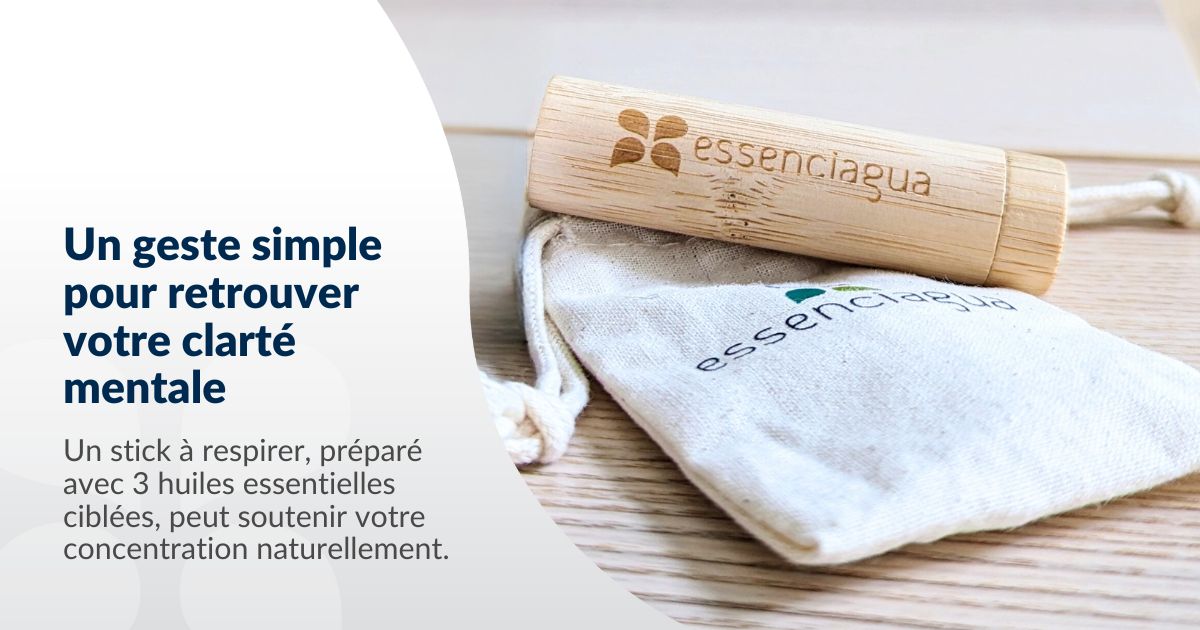
Material
- An empty inhaler stick
- A cotton wick
- The following essential oils: Laurel, Peppermint, Lemon
- More lemon? Add 1 drop of lemon.
- More fresh and stimulating? Add 1 drop peppermint.
- More woody and anchoring?
Steps
- 1. Place 3 drops of each oil on the wick.
- Inhale gently to assess the balance of scents.
- Adjust according to your preferences
- Insert the wick into the stick and close.
Use
- Inhale deeply 3 to 5 times before an activity that requires concentration (work, study, meeting...).
- Do not exceed 5 uses per day to avoid olfactory saturation.
How does it work?Inhaling essential oils stimulates the olfactory bulb, directly linked to the limbic system, the center of memory, attention and emotions.
Some molecular references
- 1,8-cineole Improves cerebral oxygenation, cognitive support
- Menthol Activates the sympathetic system, increases alertness
- Limonene Promotes dopamine, improves mood and attention
Precautions for use
- Laurier noble: not recommended in cases of asthma.
- Peppermint: well tolerated in olfaction. As a precaution, avoid use in young children or in cases of known neurological pathology. In case of pregnancy or breast-feeding, do not hesitate to seek medical advice.
- Lemon: may be irritating in high doses. Avoid direct contact with mucous membranes.
Always test a small amount first. Space out use if you feel discomfort.
Variant to diffuserThe same synergy can be used in a diffuser to create an atmosphere conducive to concentration:
- 3 drops of each oil
- Broadcast for 15 to 30 minutes in an airy space
Concentration today is not just a matter of willpower. It requires mental hygiene, a conducive environment and sometimes support from natural sources.
Essential oils don't do everything, but they can facilitate a mental transition to a more stable state of presence.
A simple, well-thought-out stick then becomes an anchor point, an olfactory signal that tells you: it's time to concentrate.