




Where do hydrosols come from?
3,000 years ago, floral waters, or hydrolats, were the only distillation products used by the ancients. Their production was simple, and complete distillation, which produces essential oils and hydrolats in the same process, was not yet known. This type of distillation did not appear until the Middle Ages, shortly before the Crusades. Hydrolats continued to be produced and appreciated for their beneficial properties, but in the last century they were abandoned in favor of essential oils, which are easier to store and transport and, above all, more lucrative in the modern economic context.
Much has been written on the use of essential oils in aromatherapy, notably on how to use them and the dilutions to use to avoid irritation of the skin and mucous membranes they come into contact with. Little has been written about hydrolats. However, the use of aromatic substances in dissolved form avoids this problem. Hydrolats, or aromatic waters in the original sense of the term, are not only non-irritating, but are also generally anti-inflammatory and soothe irritation. They are very easy to use on sensitive, elderly people, children and infants. As a result, hydrolats have enjoyed a resurgence in popularity in recent years, thanks to growing consumer interest in natural, effective, risk-free products. Thanks to their many therapeutic applications, ease of use and safety, hydrolats are the perfect answer. I’m delighted.
Today, people are talking more and more about hydrolats and their amazing effects. They can be used by anyone, from those who want to look after their health in a different way, to practitioners who want to broaden their range of treatments. We now know that hydrolatherapy is a real option for treating a wide range of health problems. The aim is not to replace essential oils, but rather to use essential oils and hydrolats wisely, complementing them where necessary, and combining them with plants in other forms, as well as with a healthy diet. Both hydrolatherapy and aromatherapy are holistic health practices, which consider the person as a whole, and call upon the plant’s totum, so precious, so often forgotten, but which all ancestral medicines sought.
Forgotten for several centuries, hydrolats are making a comeback! Today, their subtlety and efficacy are being rediscovered thanks to more meticulous production processes, more in line with their intended health use.
What is a hydrolat?
In 1826, the Nouveau Dictionnaire de médecine stated: “Eaux distillées, les hydrolats sont des médicaments composés d’eau et de principes volatils qui y sont unis par la distillation.”
According to AFNOR (Association française de normalisation, 1998), a hydrolat is an “aqueous distillate that remains after steam distillation, once the essential oil has been separated”.
Hydrolats are produced by steam distillation, most often from aromatic plants. These are known as aromatic hydrolats. Some less aromatic plants are also distilled, but only to produce hydrolats (cornflower, witch hazel, meadowsweet and others), which are by definition non-aromatic. For simplicity’s sake, the term hydrolat is used here to refer to the aqueous extract produced by distillation (steam distillation), whether from an aromatic or non-aromatic plant.
Aromatic plants represent around 10% of all plant species. These are plants that contain aromatic molecules in one or more producing organs (flowers, leaves, seeds, bark, fruit, roots). The composition of these aromatic cocktails (chemotypes) can vary according to climatic conditions, soil, altitude and the various stresses to which the plant is exposed. Plants’ chemical compounds enable them not only to grow, flower and reproduce, but also to communicate with each other and with the external environment. Certain molecules enable them to defend themselves, to protect themselves from predators and climate change; other molecules enable them to communicate, for example with pollinators. These chemical molecules (often hundreds of them) act together like an orchestra, and this overall composition, perfected by the plant over millions of years of evolution, results in a natural product that is perfectly tolerated by man and is part of the same biochemistry of living organisms.
All these components are extracted during distillation and concentrated in the hydrosol and essential oil produced.
Improved distillation techniques now make it possible to obtain high-quality hydrolats and essential oils for therapeutic purposes. Just as we talk about aromatherapy, we can now also talk about hydrolatherapy.
The hydrolat is perhaps the closest form of phytotherapy to the plant that exists, faithful to its entirety. In fact, by taking the water from the plant (hence the importance of distilling the fresh plant to obtain a quality hydrolat), it also contains all its subtlety and richness.
At first glance, essential oils and their compounds appear insoluble in water, but this is not entirely true. A small fraction of the aromatic compounds of a distilled plant remain in the distillation water (distillate). Each aromatic substance has a maximum solubility in water. When this point is reached, the aromatic substances will separate, reforming the essential oil as contained in the plant’s secretory pockets. Decantation is spontaneous, and the correctly distilled hydrosol then contains water-soluble essential oil molecules, plus water-soluble principles present in the plant and not found in the essential oil.
The hydrolat must be the result of a distillation process, and only the product of that process. It cannot be flavored water, water with added essential oil, or a mixture of hydrolat and water. For food or health use, it is all the more important that it contains no added alcohol or preservatives.
How is hydrolat obtained?
Hydrosols are obtained by distilling plants. The distillation process involves several stages.
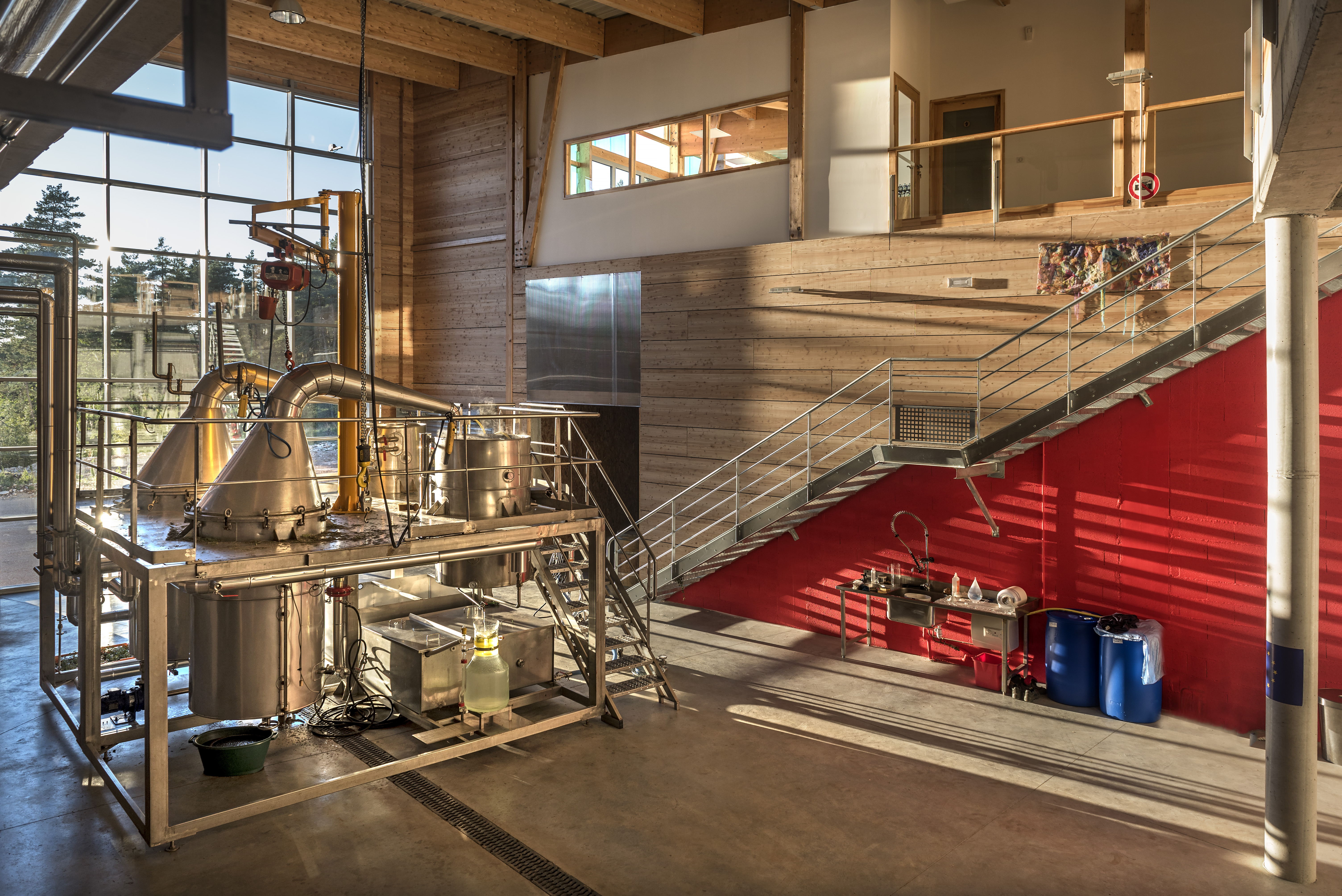
- Loading the plant into the still tank. The plant to be distilled is placed in a basket in the still. It is tamped “at the feet” so as to allow a slow and homogeneous passage of steam through the plant mass and thus ensure good mechanical contact between the plant and the steam as it passes through. To ensure optimal packing and extraction, the size of the tank is important: it should be neither too large nor too small (the optimum is between 500 and 1,500 liters).
- The “gooseneck” or “retort” closure.
- Launching the steam (ideally generated by an independent boiler) into the still.
- The distillation itself, with the steam passing through the plant mass, extracting the constituent molecules (aromatics, minerals, trace elements) of the plant as it goes. After passing through the swan neck, the water vapour is transferred to the cooler, where it gradually returns to liquid form, before emerging as a distillate in the Florentine vase.
- The natural separation in the Florentine vase of the distillate into hydrolate and essential oil, if any. The essential oil, made up exclusively of fat-soluble aromatic molecules, is generally lighter than water, and is therefore found on the surface. The hydrolat, an aqueous phase made up of the plant’s water and the water used for distillation, enriched with water-soluble aromatic molecules, minerals and trace elements (not found in the essential oil), is usually found at the bottom of the Florentine vase (or essencier). The vase florentin is ideally connected to a hydrosol collection tank to enable homogenization (totum search).
The hydrolat will benefit from being mechanically microfiltered to ensure absence of contamination, before being stored in a cool place. As a living product, it will stabilize in the same way as a wine would in a natural maturation process (aromatic recomposition).
What are the quality criteria for a hydrosol?
As with essential oils, the efficacy and safety of a hydrolat depend in part on its quality.
As we have seen, the distillation process involves plants, water (in the form of steam), a still and a system for “collecting” the distillates (the Florentine vase or essencier) and, finally, a hydrolate vat. To obtain quality products, each stage is important.
The plant
For use in aromatherapy or hydrolatherapy, it’s really preferable, in my opinion, for the plant to be organically grown. Indeed, while the distillation process concentrates the plant’s own molecules, the same is true for molecules exogenous to the plant. It is therefore important that the plants have not undergone any chemical treatment. This applies to both cultivated and wild-gathered plants, for which you can also choose to have the natural harvesting areas certified “organic”. The time of harvest and the fact that the plant is distilled fresh (not dry, to preserve its water content) are also decisive factors. In some cases, a light pre-wash in the shade is useful (for lavender, for example). But the effectiveness of the hydrosol will depend first and foremost on its active ingredient content. For this, it’s important that the distillation ratio is close to 1, i.e. that 1 kg of fresh plants has produced a maximum of 1 liter of hydrolat. The result is a hydrolat rich in active ingredients. And with an intense scent!
Water
The water from distillation, in the form of steam, extracts the aromatic molecules from the plant and combines with the plant’s water to form the distillate, which naturally separates into hydrolat and essential oil if the plant contains any. Just as it’s very important to distill organic, untreated plants, it’s also preferable to distill with spring water, untreated before and during the process.
Equipment
The alembic still, preferably made of food-grade stainless steel, as well as the steam generator and containers, must meet quality standards. For the still, smooth food-grade welds prevent bacterial or plant-to-plant contamination. A stainless-steel boiler avoids the addition of sulfites required in steel boilers to protect them from oxidation, although they are still tolerated in organic production. Dry steam, which is ideal for distillation, is obtained by passing through a high-pressure circuit before “expanding” to return to low pressure. This avoids hydrolysis, which destroys molecules. Only artisanal distillation allows us to obtain the quality of our skincare products.
**Distillation conditions
To avoid degrading plants and their aromatic molecules, it is important to distill at low pressure and low temperature. Distillation in mountainous areas allows distillation at lower temperatures (e.g. 95°C at 900 m), thanks to the low pressure of altitude.
All these conditions enable distillation to be carried out slowly and therefore for longer, with a duration optimized for each plant, so as to obtain the totality of the plant’s molecules, a guarantee of efficacy and safety.
After distillation, hydrolats should be bacteriologically tested and their composition checked before storage.
**Yield and preservation
A hydrosol distilled from fresh plants, with a good plant/water vapor ratio and under optimal cleanliness conditions (steam cleaning of stills and containers) is a hydrosol that can be used as food-grade, and can be stored naturally, without added preservatives. The aromatic molecules of which it is composed, as well as the plant’s water (according to our observations), ensure its preservation. After all, hydrosols contain only distilled (sterile) water with bactericidal molecules and large quantities of monoterpenols (aromatic molecules) with anti-infectious properties.
What is the composition of a hydrosol?
Fortunately, hydrolats are not “just” water! They are amazing liquids that smell, taste and have properties thanks to the molecules that make them up.
Essential oils and hydrosols from the same plant have different biochemical compositions, so their properties and methods of use may differ. Their concentration in aromatic molecules is, of course, incomparable: 100% for essential oils, maximum 0.1% for hydrolats. Hydrolats also contain molecules from water-soluble biochemical families, mainly alcohols, some phenols, ketones and aldehydes. They also contain minerals and trace elements, as well as other water-soluble compounds not found in essential oils. These different compositions give them truly complementary properties and modes of use.
Hydrolatherapy is therefore a gentle, complementary version of aromatherapy. Hydrolats are easily absorbed. It is perfectly tolerated by children, the frail and sensitive elderly, and can even be applied neat to mucous membranes. It can be taken over the long term without any risk of addiction or aggression (as can be the case with gastric or intestinal mucosa, for example, following a course of medication, or with essential oils over long periods or too intensively).